Today, 100 years ago, mankind first sortied
into the wild blue yonder in a powered aeroplane. As aviation
enthusiasts around the world celebrated the first centenary of
powered flight in their own ways, I studied the sky carefully
today, and would like to offer a humble personal perspective of
what aircraft and aviation mean to me.
It was a cold but clear blue sky this morning, and by 11.00 am I
had already heard the rumbling note of 48th Wing F-15 Eagles in
the area. I occasionally remark to my wife that the USAF's F-15s
are the only thing worth looking at in the skies over Lowestoft.
How blas I have become! I was just in time to see one F-15
disappearing at a rate of knots in a N.W. direction. Immediately
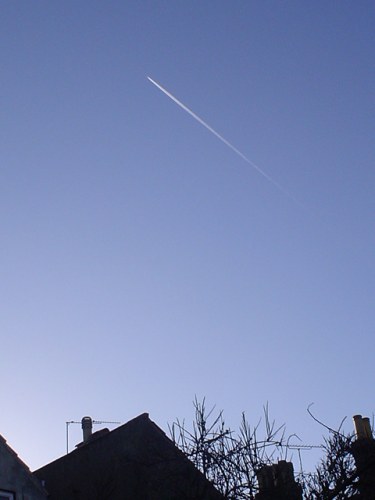
afterwards, the first of a procession of civil airliners began
crossing from W. to E., each carving a fine white contrail against
a cloudless backdrop of sky. I thought for a moment about the
passengers being blissfully ignorant of the date as they jetted
off to warmer climes for Christmas, but then again, perhaps those
Captains with a sense of history might have made some comment over
the PA system ?Out to the W. hung a big,
silvery moon. The same year that I was born, 1957, saw the
Russians launch Sputnik I, and overnight, aviation became
aerospace.
I can still vividly recall being woken up by my father in the
small hours of 21 July 1969, to watch on TV, along with millions
of others all round the world, Neil Armstrong's first "giant leap
for mankind" in the Sea of Tranquillity. The picture quality was
so bad many had difficulty determining what it was they were
looking at, but that did not diminish the enormity of the
occasion. |
- Scratch mark in the sky
- One of a procession of
civil airliners which etched a trail across the blue sky over
Oulton Broad on the morning of 17 Dec 2003.
|
My first flight was in 1970 in a Puma helicopter, then relatively
new to RAF service - and I was treated as a young 469 (Lowestoft)
Squadron ATC cadet on Summer Camp to a grand "air-experience"
passenger flight from Odiham to the Isle of Wight and back.
Unfortunately, air-sickness marred my first flight, but it was an
experience I would not have missed for anything. Like lots of other
ATC cadets, I subsequently flew in a variety of aircraft, from
Chipmunk, Husky and Wessex, to flights in Sedburgh and Kirby T.III
gliders at RAF Swanton Morley.
I contemplated a career in the RAF, but it never happened. Instead,
I began to develop an increasing interest in military aviation
history, particularly regarding the WW 2 period.

Another civil airliner passing overhead on 17
Dec 2003. Oh, for a decent zoom lens !
- Late one night in April 1999, I watched with
interest as eight aircraft, I now know them to have been US F-15s
from Lakenheath, crossed Oulton Broad in trail heading in an
Easterly direction. They were bound for Kosovo and the Former
Republic of Yugoslavia. It struck me as odd at the time, to think
that as we neared the end of the 20th century, US warplanes were
heading out from a base in Suffolk, over the Lowestoft area, to bomb
targets in Europe, in much the same ways that hundreds of B-17
Fortress and B-24 Liberator bombers of the 8th USAAF had done 55
years earlier. In retrospect, it was probably the closest I will
ever be to a real bombing raid in progress. Earlier this year, I was
also able to spot one of the giant B-52 Stratofortress bombers
heading out from RAF Fairford over the North Sea on a long-range
sortie to Iraq. It was only through information from LAS members
that I became aware these massive symbols of air-power were flying
over our town, and again, the awesome spectacle of their payloads
detonating in and around Baghdad were beamed directly to our living
rooms as it happened via TV, several hours later.
| At the going down of the sun:
The grave of Sgt Pilot Hereward Wake at St Michael's Churchyard,
Oulton. Sgt Wake, step-son of Major Selwyn Humphery, the wartime
Mayor of Lowestoft, was killed in a training accident in
Scotland on 30th Sept 1940. |
 |
That afternoon, as our Hon Chair Roger Smith was preparing to
broadcast to the nation on Radio Suffolk, I set out with my digicam
to try to capture some sunset pictures from the edge of Butcher's
Marsh, Oulton, a favourite walking spot with an excellent view of
the sky.
En route, I visited the lovely little Church of St Michael, where
two local men who made the supreme sacrifice with the RAF in WW 2
are buried. Sgt W H Wake, a trainee pilot flying with No.1 (C) OTU,
died in September 1940 when the Hudson he was flying solo in crashed
at Barrhill, Dumfriesshire. Close by lies P/O Charles Folkard,
another victim of a training accident, aged only 21, on 16th
February 1944.
Also in St Michael's Churchyard is a rather intriguing little
puzzle. Just N.W. of the Church is a short headstone bearing no name
or details, just a 1930s civil monoplane. There is obviously an
aviation connection to this grave, but I suspect the Church Burial
Register may have to be consulted before we find an answer to the
mystery?
 |
Forgotten flyer: Who lies
buried beneath the lichen-covered stone showing a 30s monoplane
at Oulton? Perhaps a vase or plaque containing further details
have been removed, but it is certainly an odd memorial worthy of
further research. |
The sun was sinking fast as I neared the railway crossing, and
already in the distance I could see the contrails of at least three
aircraft. The surprising thing was that they were crossing in
opposite directions. I contemplated the fact that aviation now
affects all our lives in one way or another. Yesterday's headlines
included the 3rd runway at Stansted and the emphasis was now on the
huge environmental damage caused by increasing numbers of jet
engined airliners, not to mention the property and countryside that
would disappear beneath the airport expansion.
I thought about some of the extraordinary aeroplanes which I had
seen in the skies over Lowestoft since I began to take an interest
in the early 70s; Concorde on air-test; the futuristic-looking SR71
Blackbird; the ungainly A-10 Tankbuster (I never did like calling it
"Thunderbolt II"); the majestic delta-winged Vulcan; the noisy
Buccaneers and Lightnings; the swing-wing F-111s, and in recent
years, the bizarre angular shape of the F-117 Nighthawk Stealth
fighter. One has only had to look out of a window from one's own
home to see a fascinating variety of aircraft, and I take great
pride in belonging to such a dedicated and highly diverse bunch of
enthusiasts as the Lowestoft Aviation Society. Not without good
cause have BBC Radio Suffolk dubbed them "Suffolk's Eyes In The
Sky".

- The sky is never still
- At least three contrails were
visible when I took this shot towards the sunset that afternoon.
- Nobody would now give it a second
thought.
I then took a further picture towards the vapour trails, and I swear
I was so intent on capturing these that I never even saw the Norwich
train passing the crossing ! Then I thought about how the train had
been superseded on internal inter-city routes by aircraft to some
extent, and how people must have shook their heads at Stephenson's
Rocket when the idea of travelling by rail first came about !
- Trains and boats (well, the
River Waveney IS close by !) and planes.
- You might need a magnifying
glass to see them, but there ARE two contrails in the background,
distant !
- I then ascended to a piece of headland with a
commanding view across the marshes to the W. and N.W. in the hope that
something would traverse the still-cloudless sky. Just as I was
beginning to think it was time to head for home, right on cue, a
fiercely-white trail came arcing across the heavens from behind me,
seemingly chasing the setting sun towards the far horizon. As I
focused for my final pictures, I could see, far off in the background,
groups of birds winging their way Eastwards. How people must have
scoffed and ridiculed the idea of man taking to the air in a flying
machine before the Wright brothers stamped their indelible mark on our
history books 100 years ago. "If God had intended man to fly he would
have given him wings" went the old chestnut. And I had to smile as I
watched the last guest at my own private 100th birthday party faded in
the distance. How far it had all come in a hundred years.
- Walking home in the gathering dusk, I saw
several more civil aircraft, looking like miniature Christmas
trees with their navigation lights, again leaving long white
vapour trails in the cold, gathering gloom. Out to the W. hung
a very bright star (Venus ?) and I then realised we were no
longer bound to this earth. While it may be with robot craft,
man is now reaching out to the planets. On Christmas day, the
Brit-made Beagle II will hopefully be descending onto the
surface of mars. It is no longer science fiction, it is
science fact. And it all began 100 years ago today with Wilbur
and Orville's first hesitant step into the unknown.
-
- Happy centenary, aviation. Here's to the
next 100 years, who knows what it may bring?
- Bob Collis
- 17th December 2003
|
-

- Sunset on a century
- What will the next 100
years bring to the skies over Lowestoft? One thing is for
certain, you can be sure LAS will be first with the news!
|
|